Free tool

AI Art Generator

An AI art generator is an art generator that turns written prompts into original images, illustrations, and visual styles.

★★★★★ 4.8 · loved by 2M+ creators

  • 5M+
    Photos edited
  • 2M+
    Happy creators
  • 4.8★
    App rating
Powered byNano Banana 2SeedreamFLUX

Everything in one place

Your whole editing toolkit

Start with the tools people reach for most — each opens in your browser, no signup to try.

See the difference

Drag to see every photo edit in real time

Remove backgrounds, unblur, colorize, and retouch — the AI does the work in seconds.

Background removedOne-click clean cutout
Object erasedRemove anything, filled in naturally
ColorizedBring old photos back to life
Sharper & upscaledUnblur and enlarge to HD

Why this matters

Why learning image creation with AI is useful

An art generator matters because it lets you make original visuals faster, test ideas cheaply, and create polished artwork without traditional drawing skills.

Make original art from a simple idea

You can turn a short prompt into a fresh visual instead of hunting through stock libraries or staring at a blank canvas. That makes concepting easier for posters, social posts, gifts, thumbnails, mood boards, and personal projects.

Test styles before you spend time or money

You can compare looks quickly, such as watercolor, comic, fantasy, or product poster, before committing to one direction. That saves revision time and helps you spot what fits your audience, room, brand, or occasion more clearly.

Create useful visuals without advanced art training

You do not need to master brushes, layers, perspective, or lighting theory to get a usable result. The topic matters because it lowers the skill barrier, so more people can make album art, invitations, mockups, and profile images.

Move from idea to finished asset more easily

Good AI art workflows help you go from rough prompt to editable output, then refine the result for real use. That is where tools like MiFoto can help, especially when you want to enhance, clean up, or repurpose the final artwork.

The basics

How does AI art generator work and what matters?

These topics explain what AI art is, how text prompts shape the result, where image quality comes from, and when these tools make sense. You will get the basics first, then the details that help you create better art.

ai art generator — topic section inline 0

Why does AI art matter now?

AI art matters because it lets you turn an idea into a visual draft fast, even if you cannot draw. That makes art useful for mood boards, social posts, book covers, concept sketches, and quick experiments before you spend money on design. A good AI image generator also helps you test style, color, and composition choices before you commit to one direction. If you want a more realistic result, an AI photo generator is often the better branch to explore, because photo tools aim for camera-like detail while art tools lean into illustration and style.

Notebook with an art prompt beside a laptop at home

How does text to art actually work?

text to art works by turning your prompt into visual instructions about subject, style, lighting, color, and layout. The model predicts pixels that match those instructions, then refines them into a finished image based on patterns learned from huge image and caption datasets. A simple prompt like “a cozy watercolor painting of a rainy bookstore window, warm yellow light, loose brush texture, vertical poster” can produce a soft illustrated scene with clear mood and format. If you want prompt structure ideas, a text to image prompt guide and a roundup on how to generate images with AI can help you write more precise requests.

ai art generator — topic section inline 2

What usually goes wrong with results?

Most weak results come from four issues: vague prompts, conflicting style requests, missing composition details, and asking for too many subjects at once. Hands, text inside images, tiny facial details, and exact object placement can still fail if your instructions are broad or overloaded. It also helps to match the model to the job, because some AI models are better at painterly scenes while others handle graphic posters or anime more cleanly. If portraits are your focus, best AI portrait prompts are worth studying because face prompts need stronger detail about angle, light, and expression.

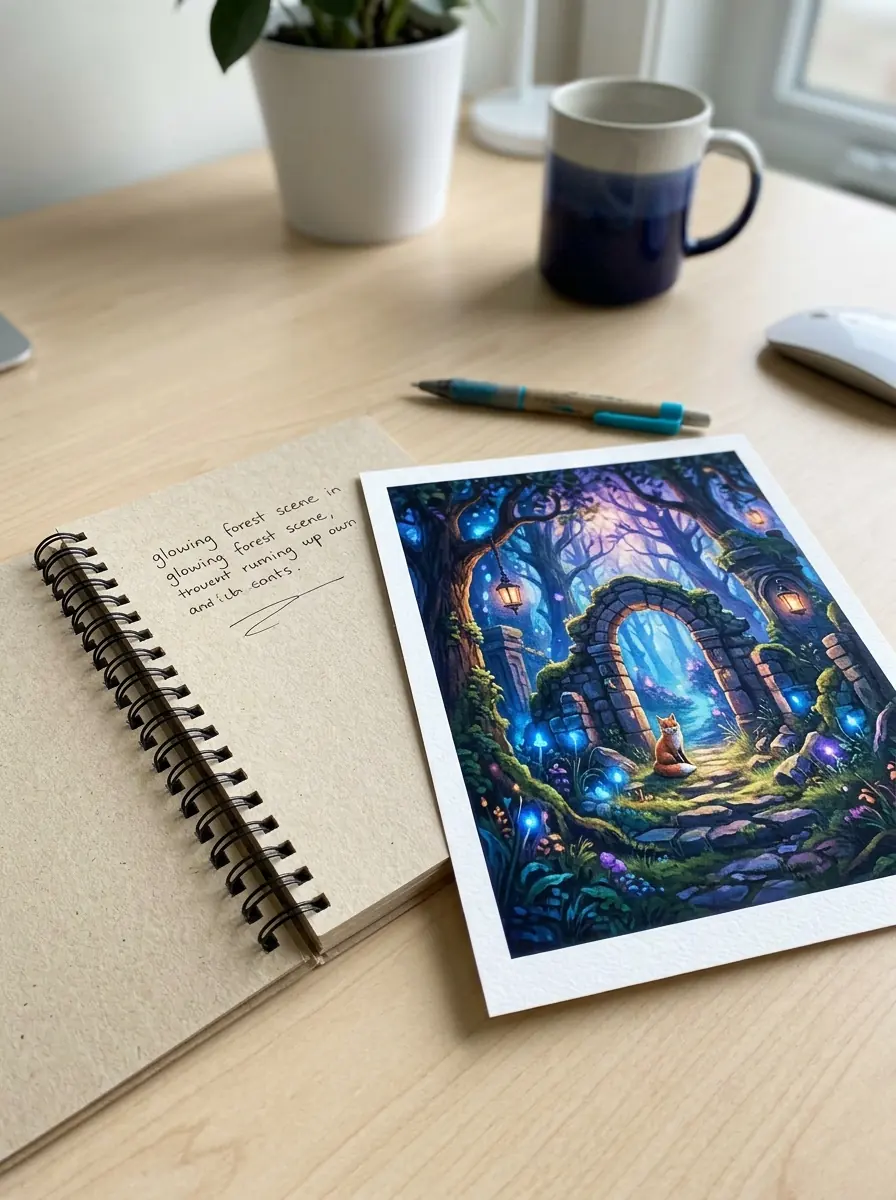
Finished colorful art print displayed in a home workspace

How can you get better art faster?

An AI painting generator works best when you start with a clear subject, one style, and a few concrete visual cues. MiFoto helps by giving you a simple place to test prompts, compare outputs, and move from rough concept to polished image without learning pro design software. You can ask for painterly scenes, stylized posters, or character concepts, then refine with clearer wording instead of fighting complicated settings. If your goal is a stylized identity image, an AI avatar generator gives you a narrower path, while an AI logo generator is better for simple brand marks than full artwork.

ai art generator — topic section inline 4

What should you explore next?

The next step depends on the result you want: portraits, branding, realistic scenes, or profile images for social apps. If you want a character or profile-style result, an AI art maker can overlap with an AI profile picture generator, but the latter is built for tighter crops and clearer face framing. If you plan to generate AI art for campaigns or storefronts, compare style-driven outputs with photo-based workflows so you know when realism matters more than illustration. This is also where prompt practice pays off, because small changes in medium, camera angle, or color mood can shift the whole image.

How it works

How does an AI art generator work from prompt to finished image

You describe the art you want, the model turns those words into visual patterns, and you refine the result until the image matches your idea.

Woman typing an art prompt on a laptop at a kitchen table
1

Step 1: Describe the image clearly

Start with a short prompt that names the subject, style, mood, lighting, and framing. Specific details give the model stronger direction, so “orange cat in watercolor style by a window” works better than “make a cat.”

Woman reviewing draft art results generating on her laptop
2

Step 2: Let the model build and refine the scene

The system interprets your prompt, matches it to patterns learned from many images, and generates several visual options. If the first result is close but not right, you can adjust the wording to change color, composition, detail, or style.

Woman viewing a finished AI-made artwork on her laptop
3

Step 3: Pick the best result and save it

Choose the version that fits your goal, then export it for sharing, design work, or another editing step. Many people run one more pass with added instructions to sharpen the concept before they keep the final image.

What you can make with text and style prompts

Create portraits, posters, concept art, social graphics, product scenes, and custom visuals for work, school, and everyday ideas.

Hobby creator holding a colorful printed AI art landscape at home

Artists and hobby creators

You can turn a rough idea into a finished image without sketching skills. This works well for posters, mood boards, character ideas, and personal AI art you want to share or refine.

Small business owner preparing product visuals on a clean table

Small business owners and sellers

You can make fresh visuals for product launches, social posts, menu art, and simple brand concepts. It helps when you need images fast but do not have a studio, photographer, or design team.

Family holding a stylized portrait print made for sharing or gifting

People making portraits, gifts, and social posts

You can create stylized portraits for birthdays, profile pictures, party invites, and fun edits with friends. An art generator is useful when you want a custom look for a real moment, not a generic stock image.

Features

What you can make and refine

Create original art from text, explore different visual styles, and polish the final image for sharing, profiles, products, or personal projects.

Generate from plain prompts

Type a short description and the model turns it into art without manual drawing or layer work. The system reads subjects, style words, lighting, color, and composition cues together, so a simple prompt can produce a usable first draft fast.

Switch between image models

Different models are better at different jobs, like realistic scenes, stylized illustrations, or cleaner typography. MiFoto supports top options such as Nano Banana 2 and Seedream, so you can match the model to the kind of art you want instead of forcing one model to do everything.

Set format, framing, and detail

You can guide the result before generation by choosing the shape and layout that fit your goal, like a square social post, a tall profile image, or a wide banner. That control helps the art land closer to the right crop, subject size, and visual balance on the first pass.

Refine outputs with follow-up edits

Good art often comes from iteration, not one perfect prompt. After generating an image, you can improve sharpness, clean up distractions, or adjust the final look with MiFoto’s built-in editing tools instead of restarting from zero.

Reuse results for avatars, logos, and profile photos

One finished image can become a lot of useful assets with the right follow-up tool. If you want a character-style portrait, a simple brand mark, or a polished social image, you can continue with the AI avatar generator, AI logo generator, or AI profile picture generator for a more specific result.

Turn your idea into art you can use

After learning how text prompts shape style, subject, and detail, you can make your own images and artwork in one place.

Write a prompt and get original art fast
Good for posters, social posts, profile images, and concept drafts
Works in your browser with no complex setup

AI art generator questions, answered

What is an AI art generator?
An AI art generator is a tool that turns a text prompt into visual art. You describe a subject, style, mood, or scene, and the model creates an image that matches those instructions. Some tools focus on painterly looks, while others aim for photos, posters, or character art.
How does an AI art generator work?
An AI art generator works by reading your prompt, mapping the words to visual concepts, and predicting what the final art should look like. The model has learned patterns from many image and text pairs, so it can combine objects, lighting, styles, and composition into a new image.
Can AI art make original images from a short prompt?
Yes, AI art can produce original-looking results from only a few words, but the output is usually better with more detail. Adding the subject, setting, camera angle, color palette, and mood gives the model clearer direction. If you want prompt help, see the text to image prompt guide.
What is text to art, and how is it different from editing a photo?
Text to art creates a new image from words, while photo editing changes an image you already have. If you want to remove a background, fix blur, or retouch a portrait, editing is the better fit. If you want a brand-new scene, character, or concept, generation makes more sense.
When should you use an AI painting generator instead of a realistic image tool?
Use an AI painting generator when you want brush texture, stylized color, fantasy scenes, or a hand-made art feel. Choose a realistic generator when you need product concepts, ad-style visuals, or lifelike portraits. The best choice depends on the look you want, not just the prompt.
Can an AI art generator create portraits, logos, and profile images?
Yes, many generators can handle those jobs, but a dedicated tool often gives better controls for each format. For a face-first result, use an AI avatar generator or an AI profile picture generator. For brand marks, an AI logo generator is a better match than a general art tool.
Why does AI art sometimes ignore part of the prompt?
AI art may miss details when the prompt is vague, overloaded, or contains conflicting instructions. Long prompts with too many style requests can weaken the main idea. A clearer prompt with one subject, one style, and two or three important details usually gives a more accurate result.
What makes a good prompt for an AI art generator?
A good prompt names the subject first, then adds style, lighting, composition, and quality cues. For example, 'golden retriever on a red sofa, warm window light, watercolor style, soft edges' is stronger than 'cute dog art.' For more examples, read how to generate images with AI.
Can an AI art generator make photo-like images too?
Yes, many tools can create photo-like results as well as illustrated ones. If your goal is a realistic scene rather than painterly output, an AI photo generator may fit better. If you want to compare model behavior, the AI models page helps explain why outputs can look different.
How can you get better faces and character poses in AI art?
Start with a precise description of age, expression, pose, framing, and lighting, then keep the rest of the prompt simple. Portrait results improve when you state the camera distance, such as close-up or half-body, and the mood. For character-focused examples, check best AI portrait prompts.
Your first piece of art starts with a few words

Turn a simple prompt into a finished image you can share, save, or keep refining in your browser.

  • Free to try
  • No design skills needed
  • Works right in your browser
Finished AI artwork printed beside a handwritten prompt on a desk

Explore more